

Everybody is talking about the challenges of distributed collaboration in companies. There are conferences, symposia and many blog posts on best practices dedicated to this topic. Often it’s only about the collaboration between three or fewer teams or even just between employees. Thanks to good video conferencing systems, it seems as if we are gradually getting a better grasp of the distributed work between individuals, or at least knowing what would work well in theory.
But what if a company has 15 teams spread across all continents developing a product together? Then we have to deal with a completely different situation. Suddenly the question comes up, if it is worthwhile bringing everyone together in one place. From a productivity point of view, yes. From a cost point of view, often no.
When 15 teams in a large organization develop a product together, the Scaled Agile Framework® (SAFe®) is right around the corner. The Program Increment Planning, or more commonly PI Planning, is carried out four to five times a year. Scaled Agile underlines the importance of PI Planning in SAFe® by stating:
”If you are not doing it, you are not doing SAFe®”.
PI Planning goes through various phases. The biggest collaboration takes place during the so-called “team breakouts”. The teams estimate their velocity for each of the iterations to be planned. In addition, each team plans the user stories needed to deliver the features on time. SAFe® writes that this planning should be visible to everyone involved. So, absolute transparency for everyone. If one team identifies a dependency to another team, they talk to each other and then visualize it on the Program Board.
If you imagine PI Planning that way, it works very well when everyone is in the same room. But now back to the distributed situation.
Distributed SAFe® PI Planning
In case of distributed PI Planning, we have to deal with the following challenges:
- What is the channel for spoken communication?
- Where do people meet to discuss dependencies or problems?
It is important that only one video conferencing system is defined as the communication channel. In addition, some of our customers provide separate rooms so that you can ping a colleague at another location to discuss things.
- How do we achieve full transparency when each team plans on paper?
- How do we keep the Program Board synchronized across multiple sites?
If the Program Boards aren’t in sync, the teams plan based on wrong facts, which results in a chaos that can only be corrected spending a lot of time.
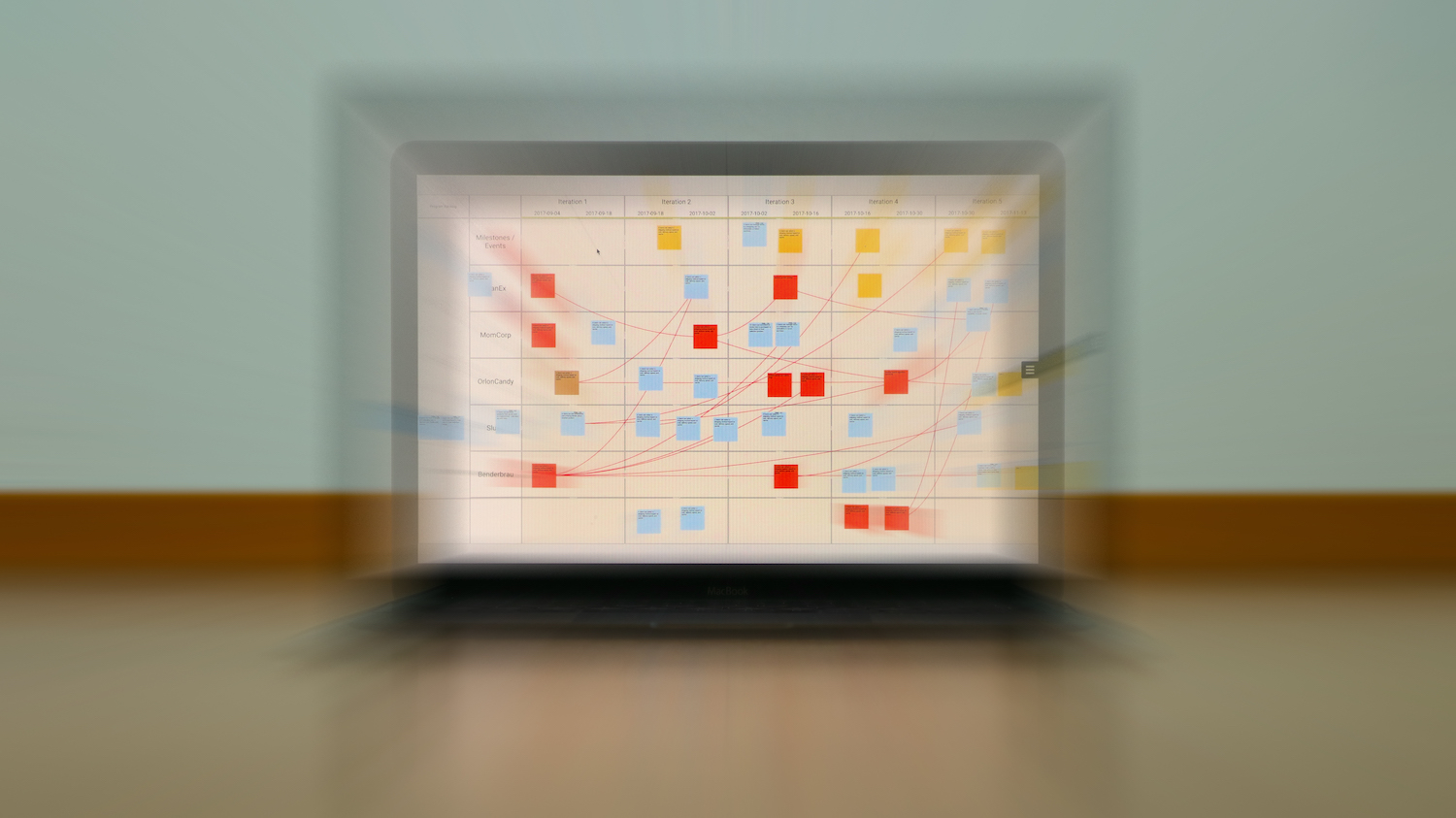
Rentouch’s PI Planning app offers real-time synchronized boards that are no different in logic and handling than paper boards. The Release Train Engineer even has the ability to predefine all sticky types that are relevant to the teams during planning. This means that all boards speak the same language, which simplifies communication even further.
Every team can access every team board and get an overview of the planning status, no matter where they are. “Visible to all” is how SAFe® puts it. The Program Board is also synchronized.
PI Planning app synchronized with AGILE HIVE
After PI Planning, there is often one question left: ”And now? What do we do with all the handwritten post-its?” There is a simple solution for this too. The PI planning app can be easily synchronized with different ALM tools like Jira. It can also be linked to //SEIBERT/MEDIA’s AGILE HIVE, so that the teams can return to their workplace directly after planning, log in to Jira and start over immediately with the planning results from the PI Planning.
If you would like to take a closer look at how to scale agile, you can learn more here www.scaledagileframework.com
More about the PI Planning app: www.piplanning.io
Sign up for a free 14 days trial today: trial.piplanning.io
About the author
 As co-founder, Raphael Vincent Sigg is responsible for business development and partnership building at Rentouch. He is a convinced lean innovation practitioner and supports the functional development in the PI Planning app.
Lesen Sie diese Seite auf Deutsch


